A Brief History Of Christianity
Compiled by Rev. Dr. Carmelo Mercado
Throughout Christian history, many churches have sought to recapture the spirit and vitality of the “New Testament church” (which itself faced both internal challenges and external pressures). These renewal movements have emphasized theology, worship, education, ethical practice, and systems of church governance in their efforts to be faithful to the Gospel.
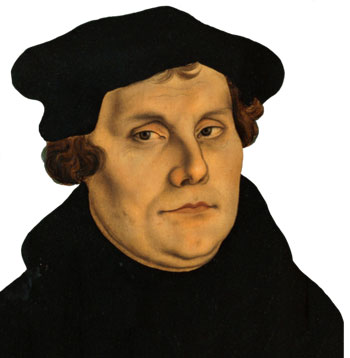
In particular, Protestant churches trace their roots to the Reformation of the sixteenth century, begun by Martin Luther and continued by other reformers such as Ulrich Zwingli, John Calvin, and John Knox.
The Early and Persecuted Church
Following the life, death, and resurrection of Jesus Christ, Christianity began in Jerusalem through the missionary work of the Apostles. By the end of that century, the Gospel had reached the heart of the known world—Rome.
During the first three centuries (30–313 A.D.), Christianity was often a courageous and faithful movement whose followers faced constant danger with remarkable conviction. Many believers gathered secretly in catacombs to escape imperial persecution; countless others suffered martyrdom for their faith.
The Imperial and Medieval Church
In 313 A.D., Emperor Constantine issued the Edict of Milan, granting freedom of religion and ending the persecution of Christians. Later, in 380 A.D., under Emperor Theodosius, Christianity became the official religion of the Roman Empire through the Edict of Thessalonica.
While this new status allowed Christians to worship freely and led to the adoption of the Nicene Creed, it also opened the door to secular influences that infiltrated the Church and diluted the original zeal and purity of the faith. The once humble, persecuted Church had now “Christianized” the empire.
During the Middle Ages (5th–15th centuries), corruption, violence, and moral decline marked much of the dominant Church’s leadership. Many clergy were poorly educated or had purchased their positions; some openly violated vows of celibacy. Even monasteries—once centers of learning and devotion—often fell into luxury, idleness, and complacency.
Yet, even in this downcast era, God raised up remarkable men and women of integrity and spiritual depth, such as Francis of Assisi, Julian of Norwich, and Catherine of Siena.
The Reformation: Martin Luther and Ulrich Zwingli
The Protestant churches emerged from what is known as the Reformation—a renewal movement that changed the course of world history.
The movement’s most prominent leader was Dr. Martin Luther (1483–1546), a German Augustinian monk, theologian, and musician. On October 31, 1517, Luther became the catalyst for change when he famously nailed his Ninety-Five Theses on the door of the University Church in Wittenberg, Germany. His intent was to protest the sale of indulgences—documents promising forgiveness of sins in exchange for money to finance church projects such as St. Peter’s Basilica.
Luther’s study of the Epistle to the Romans convinced him that salvation and forgiveness are gifts of God’s grace received by faith, not by human effort or purchase. When pressured to recant his writings in 1521, Luther boldly declared before a tribunal:
“Unless I am convinced by the testimony of Scripture and plain reason… I am bound by the Word of God. To act against conscience is neither right nor safe. Here I stand. I can do no other. God help me.”
Although Luther sought reform, not separation, his movement led to the birth of the Lutheran Church—aided greatly by the recent invention of the printing press, which spread his writings throughout Europe and reshaped its religious landscape.
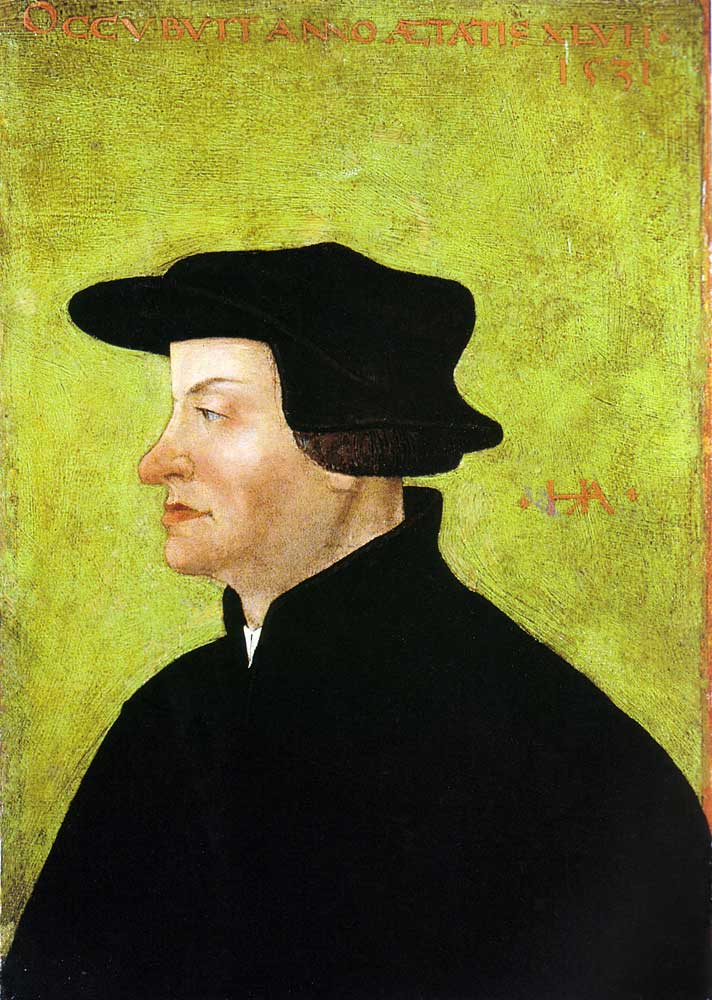
Another contemporary reformer was Ulrich Zwingli (1484–1531), a Swiss pastor, musician, and theologian who reached conclusions similar to Luther’s through his own study of Scripture. Leading the Reformation in Switzerland, Zwingli emphasized the authority of the Bible, the sovereignty of God, and a simplified form of worship. Though he differed with Luther over the meaning of the Lord’s Supper, he shared the same passion for returning the Church to its biblical foundations and moral integrity.
The Reformed Church: John Calvin in Geneva
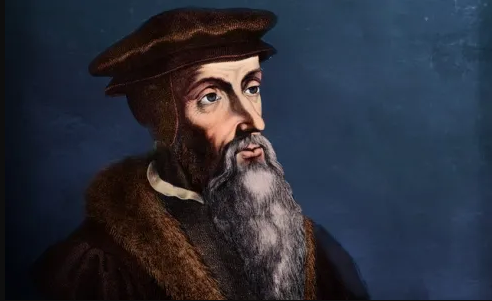
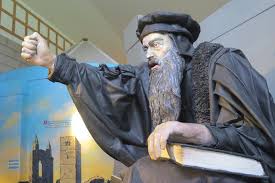
John Calvin (1509–1564), a French theologian and lawyer, became one of the most towering leaders of the Reformation and the spiritual founder of Presbyterianism. Living in exile in Geneva, Switzerland, after fleeing persecution in France, at the age of 26, Calvin wrote and revised several times his monumental work, Institutes of the Christian Religion (1536), which systematically presented the core teachings of Reformed theology. As a second-generation reformer, Calvin stressed:
- the sovereignty of God,
- salvation by grace through faith,
- the inability of humanity to save itself, and
- the Scriptures as the supreme authority for belief and conduct.
Calvin’s influence extended far beyond theology. He established a representative form of church government that balanced power among elected elders, which later inspired aspects of modern democratic systems. A brilliant Renaissance, multilingual scholar, Calvin promoted education, moral responsibility, disciplined worship, stewardship, and participatory civic governance.
If Luther was the “heart” of the Reformation, Calvin was its “mind.” His theology shaped not only religion but also Western culture. Today, those influenced by his theology are known as Reformed or Presbyterian, reflecting a faith that is both intellectually rigorous and biblically grounded.
Calvin’s View of Church and Civil Government
Calvin’s personal experiences as an exile under monarchy molded his distrust of both authoritarian rule and mob democracy, and they shaped his vision for church governance.
Calvin envisioned a balanced model where decisions were made collectively by representative bodies, avoiding the extremes of tyranny and chaos. Rejecting both hierarchical rule (which concentrated too much power in individuals) and pure congregational democracy (which could become mob rule), he developed a balanced, representative system that emphasized shared authority—a model still used in Presbyterian polity today. This principle of shared accountability has become foundational to Presbyterianism, where councils discern God’s will together.
John Knox and the Presbyterian Church in Scotland
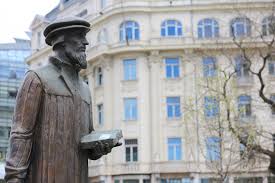
John Knox (1506–1572), a Scottish reformer and disciple of Calvin, founded the Presbyterian Church of Scotland. After studying under Calvin in Geneva, Knox returned to Scotland and organized the first General Assembly in 1560, establishing presbyteries and synods and adopting the Reformed faith.
In the Presbyterian system, the people elect elders (presbyters) to govern the church on their behalf. Today, the Presbyterian Church (USA) follows this pattern through four governing councils:
- Session (local congregation)
- Presbytery (district congregations)
- Synod (regional presbyteries)
- General Assembly (national church)
The Modern and Missionary Church in America
The American Revolution (1776) was so strongly supported by Presbyterians that the British called it “the Presbyterian Rebellion.” Among the signers of the Declaration of Independence were fourteen Presbyterians, including the only clergyman, the Rev. John Witherspoon.
Presbyterian ideas about human potential and sin shaped the U.S. Constitution, which distributes power among representative bodies and includes checks and balances among the executive, legislative, and judicial branches—principles rooted in Reformed theology.
American Christianity has since experienced cycles of revival, division, and reunion:
- The First Great Awakening (1700s) divided churches into “Old Side” and “New Side.”
- The Second Great Awakening (1800s) emphasized revivalism and personal conversion.
- The Civil War era (1861) split denominations over slavery.
- The 20th-century modernist-fundamentalist debate wrestled with biblical interpretation, science, social ethics, and ordination of women and other marginalized groups.
Despite internal conflicts, missionaries from many denominations carried the gospel globally—to Latin America, Africa, and Asia—where today the Church often grows more rapidly than in the West. Presbyterians have played a major role in missions, education, and social reform worldwide.
The Postmodern Church
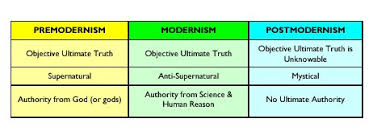
Across history, Christian civilization has passed through three broad phases:
- Premodern (before 1648): Faith and biblical authority were largely unquestioned.
- Modern (1648–1945): Reason and science were exalted above Scripture and tradition, leading to both technological progress and moral disillusionment (as seen in the horrors of war and genocide).
- Postmodern (since the 1960s): Skepticism toward absolute truth and institutions prevails. There is a turn toward individual experience as the measure of meaning. Many people now define “truth” by personal experience and emotion rather than by revelation or reason.
This mindset affects today’s churches as well. In this new age, denominational loyalty has waned, and individuals seek congregations that meet personal or family needs or align with personal preferences—rather than institutional identity. Many now view truth as subjective.
The Church must navigate this landscape—remaining rooted in Scripture, faithful to the gospel, and relevant in a culture of doubt. The challenge is to engage diverse communities while continuing to be grounded as the “church Reformed and always [in need of] being reformed according to the word of God” (or in Latin, Ecclesia reformata, semper reformanda secundum verbum Dei).
Church Governance: Three Main Models
Christian denominations differ not only in doctrine or worship style but also in how they govern themselves—how leaders are chosen, how authority is exercised, and how the congregation participates.
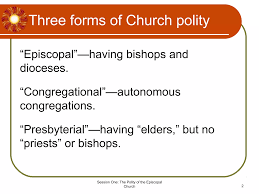
Three broad biblical patterns exist:
- Episcopal (Hierarchical) – Ruled by bishops (e.g., Roman Catholic, Orthodox, Anglican/Episcopalian, Lutheran, Methodist). Authority rests largely in the clergy rather than the people. Generally, bishops oversee churches; clergy hold central authority. Members have limited voice in major decisions.
- Presbyterian (Representative) – Led by elders chosen by the congregation (e.g., Presbyterian Church [U.S.A.], Reformed Church in America, Cumberland Presbyterian, Evangelical Presbyterian Church, ECO, Presbyterian Church in America, Orthodox Presbyterian Church). Authority is shared between clergy (teaching elders) and laity (ruling elders) through elected representative councils.
- Congregational (Democratic) – Governed by members themselves (e.g., Baptist, Disciples of Christ, United Church of Christ, Mennonite, Wesleyan, Adventist, some Pentecostal churches). Decisions are made directly by the whole membership. Final authority lies with the local congregation.
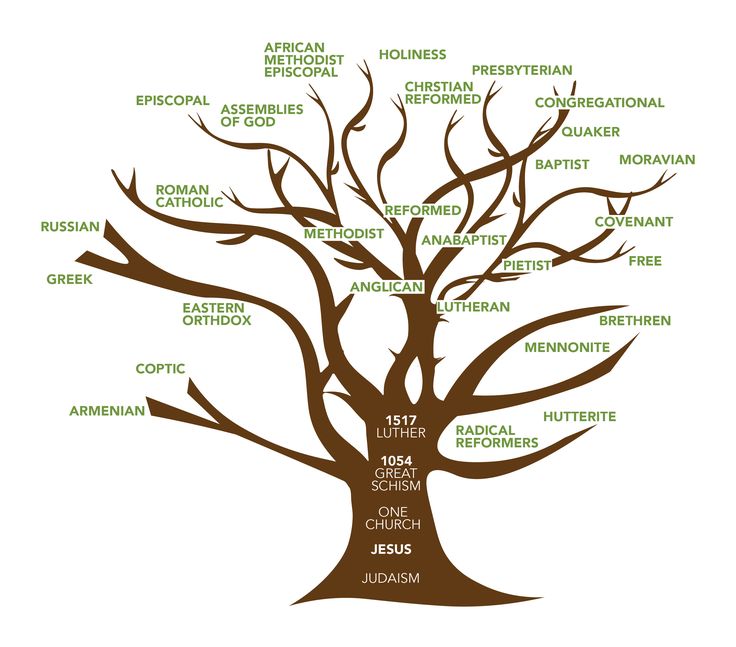
The Christian Tree and Its Denominational Branches
The history of the Christianity can be imagined as a “tree” with three main branches (Orthodox, Catholic, Protestant)—each rooted in the gospel, growing through the centuries to 2.4 billion followers, and spreading as “leaves” into many expressions of the one universal Body of Christ. All are shaped by distinct cultures, histories, and theologies. Though the branches differ in form and emphasis, they all draw life from the same root or source—the one faith and shared confession in Jesus Christ.